
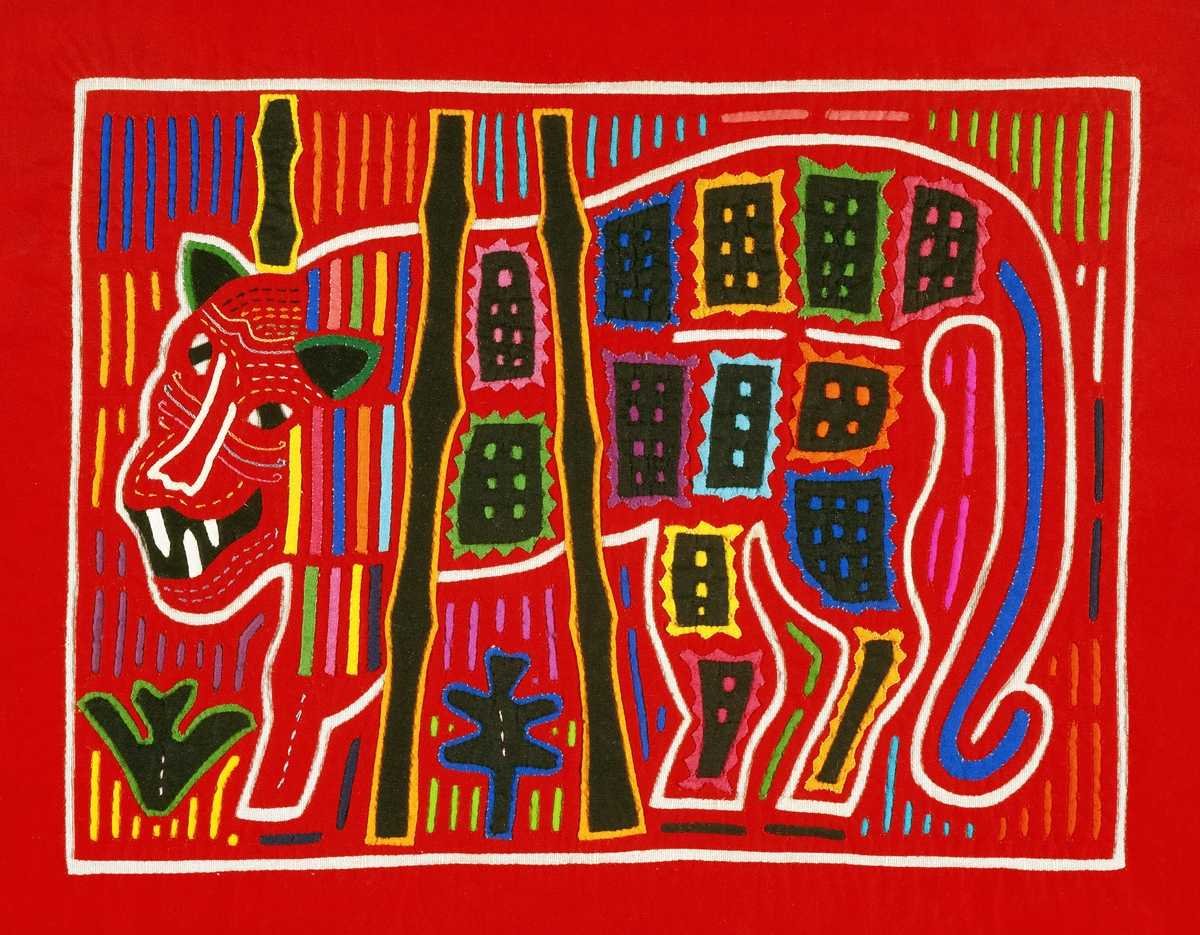
MOLAS: textile design & political identity
"Clothes aren't going to change the world. The women who wear them are." Anne Klein
What you wear can say who you are, what you believe, and what you refuse to give up. Few garments prove that better than the mola, the layered, hand-stitched blouse panel of the Guna women of Panamá.
Molas are bright, intricate, and instantly recognizable. They are also the product of a long struggle over who gets to decide how a people dress, and, ultimately, how a people govern themselves.


What is a mola?
In Dulegaya, the Guna language, mola simply means "clothing" or "blouse." Today the word usually names the decorated front and back panels sewn into a woman's blouse (the dulemor). Traditional Guna dress is a full ensemble: a wrapped patterned skirt, a red and yellow headscarf, strands of beads wound around the arms and legs, a gold nose ring, and earrings. The mola is its showpiece.
The Guna live along Panamá's Caribbean coast and on the San Blas islands, in the autonomous territory of Guna Yala. Their textile tradition is widely believed to descend from the geometric designs women once painted on their bodies with natural pigments. After contact with Europeans, those patterns moved onto cloth.
How a mola is made
Molas are built with reverse appliqué. Instead of stitching shapes onto a background, the maker stacks several layers of colored cotton, typically two to seven, and cuts down through them. Each cut opens a window onto the color beneath. The raw edges are folded under and sewn down with tiny, nearly invisible stitches.
Designs have always evolved. Early panels favored abstract geometry; later makers added birds, sea creatures, flowers, and scenes from everyday life, and sometimes even cartoons and other pop-culture imagery. The craft absorbs the world around it without losing its method.
Dress as resistance
Because mola dress was so central to Guna identity, it became a target. In 1919, the Panamanian government began pressing the Guna to assimilate, and traditional dress and nose piercing for women were discouraged and banned as part of a drive to "modernize" Guna society and extend state control.
- 1919: Panama pushes assimilation, restricting mola dress and nose rings.
- 1925: The Guna rise up in what is known as the Guna (or Dule) Revolution, defending their culture and territory.
- After 1925: Traditional dress becomes a visible statement of defiance. On some more Westernized islands, women were pressed to adopt it, even those who had never worn it.
- Later decades: The Guna secure recognized autonomy in Guna Yala, among the strongest examples of Indigenous self-rule in the Americas.
That arc is why many describe the mola as more than decoration. It was one of the visible markers a community held onto, and defended, on its way to self-government.
Why it still matters for design
The mola's lessons carry well beyond Panamá: bold color contrast, depth built from flat layers, and a pattern language that tells stories. Those qualities are why mola aesthetics keep resurfacing in contemporary fashion and home design, and why it matters to credit where the form comes from.
Mola-inspired pieces from CGK.ink
Our mola-style designs are an homage to the layered color and playful motifs of the tradition. They are inspired by the art form, not made by Guna artisans. To buy authentic molas, look for cooperatives and sellers who work directly with Guna makers.
Further reading: Guna people and Mola (art form) on Wikipedia.
Showing 829–840 of 1358 resultsSorted by latest
-
Racinet: Japonais Capri Leggings
$34.00 -
Complex Temple Round Toe Boots
$110.00 -

My Tunicate Buddy Tee
$17.00 -

Tomb of Sultan Selim II | Türbe-i Sultan Selim II Jewelry Box
$65.00 -

James Owen: Turkish No. 3 Jewelry Box
$65.00 -
Henri Rousseau: Virgin Forest with Sunset (1910) Jewelry Box
$65.00 -
Gustav Klimt: Farm Garden with Sunflowers, 1905-06 Jewelry Box
$65.00 -

Masjed-e Jāme’, Isfahan, Iran Jewelry Box
$65.00 -

The Vakil Mosque (مسجد وکیل) Jewelry Box
$65.00 -

Geometric Islamic Design Jewelry Box
$65.00 -

Visit Cuba! Luggage Tag
$19.00 -

Lago di Lugano Luggage Tag
$19.00